CFA to Naira Rate Today: How It's Set and Why It Changes
You check the CFA to naira rate in the morning, check again in the afternoon, and it's different. Three apps quote three different numbers. A friend in Douala swears she got more naira last month for the same amount.
Nothing strange is happening. Once you understand how this rate is built, you can work it out yourself in about ten seconds, and you'll know immediately whether someone is giving you a fair deal.
The short answer
The CFA franc doesn't really move. The naira does.
Every change you see in the CFA to naira rate comes from the naira side, plus small movements in the euro. That's the whole story. The rest of this article explains why, and what to do with that knowledge.
Half of the rate is fixed
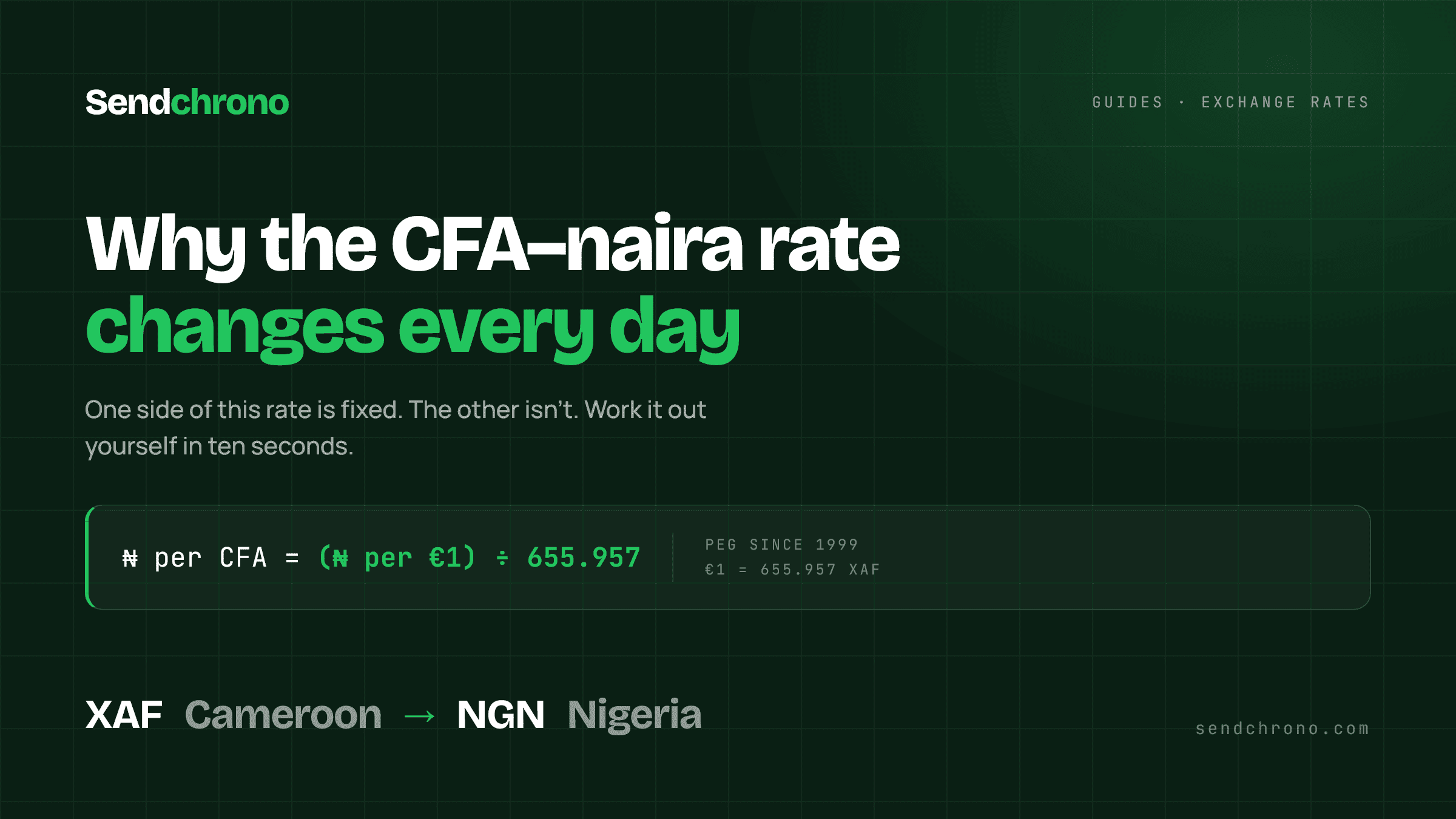
The Central African CFA franc (XAF), used in Cameroon, Gabon, Chad, Congo, Equatorial Guinea and the Central African Republic, is pegged to the euro. One euro is always worth 655.957 CFA francs, and that figure has held exactly since 1999. The Bank of Central African States (BEAC) manages the currency, and France guarantees its convertibility.
So when you hold 100,000 XAF, you effectively hold a fixed number of euros: about €152.45. That number is the same today, next week and next year.
A useful detail: many Nigerian rate websites quote the West African CFA (XOF) rather than the Central African one. The two currencies have the same value but aren't interchangeable. For rate-checking purposes, an XOF quote is also your XAF quote.
The other half floats
The naira is a floating currency. Its value is set by supply and demand for foreign currency in Nigeria, and it trades in two places: the official market, which the Central Bank of Nigeria (CBN) publishes daily, and the parallel or "street" market.
On 20 September 2026, the CBN rate for one euro was about ₦1,526, while the parallel market sold euros at around ₦1,590.
How to calculate it yourself
Because the CFA is fixed to the euro, the formula is simple:
Using the numbers above:
| Source | ₦ per €1 | ₦ per 1 XAF | 100,000 XAF gets you |
|---|---|---|---|
| CBN official | ₦1,526 | ₦2.33 | ≈ ₦232,600 |
| Parallel market | ₦1,590 | ₦2.42 | ≈ ₦242,400 |
Reference rates recorded 20 September 2026. Peg: €1 = 655.957 XAF.
That's the entire calculation. If someone offers you a rate far below the official line, you now know by how much.
Why the rate changes every day
Since the CFA side is locked, the rate moves when either the naira or the euro moves. These are the main drivers:
- Dollar supply in Nigeria. Most of Nigeria's foreign exchange is priced in US dollars, so anything affecting dollar supply affects the naira. When the CBN sells dollars into the market, the naira usually strengthens. On 10 September, for example, the naira recovered to ₦1,328 per dollar after the CBN sold roughly $151 million.
- Oil. Crude exports are Nigeria's biggest source of dollars. When oil prices or output rise, more dollars come in and the naira tends to firm.
- Interest rates and inflation. High interest rates make naira assets attractive to foreign investors, which brings dollars in. The CBN has held its benchmark rate at 26.50%, and headline inflation eased to 15.43% in July 2026. Nigeria's rate committee meets again this week, and its decision will be felt in the exchange rate.
- The euro against the dollar. This one catches people out. Because the CFA is tied to the euro and the naira mostly trades against the dollar, a stronger euro means more naira per CFA, even if nothing happens in Nigeria at all. European decisions matter too: the European Central Bank raised rates in June 2026 for the first time in almost three years, which feeds through to CFA countries.
- Seasonal demand. Demand for foreign currency spikes around school fees, festive seasons and import cycles, and prices move with it.
A rough rule: every 1% move in the naira-per-euro rate shifts 100,000 XAF by about ₦2,300. Small daily moves add up on large transfers.
Official rate vs parallel rate
The gap between the two markets has narrowed a lot. Against the dollar, the premium is now around 6 to 7 percent, smaller than in past years. That's why many people who used to rely on street changers now prefer formal, traceable channels. The difference is often smaller than the risk of carrying cash or trusting a stranger.
Why every app shows a different rate
When you send money, the rate you're quoted isn't the raw market rate. It's the market rate minus the provider's margin. Providers differ in three ways:
- Which market rate they start from. Official, parallel or somewhere between.
- How much margin they take. Some take it in the rate, some charge a separate fee, some do both.
- How fast they update. A rate that's a few hours old can be noticeably off on a volatile day.
This is why "zero fee" alone tells you nothing. A provider with no fee but a poor rate can cost you more than one with a small fee and a good rate.
How to check you're getting a fair deal
Before you send, do this:
- Ask one question: how much naira will arrive? Ignore the fee and rate separately. Compare the final amount the recipient gets for the same CFA amount.
- Check it against the formula. Take today's naira-per-euro rate, divide by 655.957, and multiply by your amount. You'll know exactly how far below the market you are.
- Make sure the quote is locked. The rate you see should be the rate you get, not an estimate that changes after you've paid.
- Check the timing. A good rate means little if the money sits for three days.
How Sendchrono sets its rate
We start from the live market and show you one number before you pay: the exact naira amount your recipient will receive. Our margin is built into the rate. There's no separate transfer fee on top, and the amount you see is the amount that arrives. Larger transfers get a better rate, and we show that on screen as you type.
You pay from MTN MoMo or Orange Money with a single USSD code, we confirm your payment automatically, and the naira lands in the recipient's Nigerian bank account, usually within 30 minutes.
Frequently asked questions
Is the CFA franc stable?
Against the euro, yes, completely. It's fixed. Against the naira, the dollar or any other currency, it moves whenever those currencies move against the euro.
Why is the XAF to NGN rate different on Google?
Google shows a mid-market reference rate, usually based on official data. No provider can actually give you that rate, because every transfer has a cost. Use it as a benchmark, not a quote.
Is XAF the same as XOF?
Same value, different currencies. Cameroon uses XAF; Senegal, Côte d'Ivoire and other West African countries use XOF. A rate quoted for XOF works as a reference for XAF.
When is the best time to send CFA to Nigeria?
Nobody can predict exchange rates reliably, including us. If the amount matters, compare the arriving naira amount across providers on the day, and avoid sending during known high-demand periods if you have the flexibility.
Does Sendchrono charge a fee?
There is no separate transfer fee. Our margin is built into the exchange rate, so the naira amount you see before you pay is the amount that arrives.
Rates in this article are for illustration and were accurate on 20 September 2026. Exchange rates change throughout the day. For a live quote, check the rate in the Sendchrono app before you send.